
News & Commentary
Keeping the Promise
This election year is important. It’s probably one of the most important election years we will encounter in our lifetimes – and every citizen should be allowed to participate in choosing not only our national leaders but also determining Alabama’s future.
By Kynesha Brown, Voting Rights Advocate
Alabama’s Effort to Suppress Black Vote Couldn’t Prevent Huge Turnout
Some 1.3 million Alabamians – more than twice as many who voted in the primary – turned out to vote in Tuesday’s special election to fill the U.S. Senate seat vacated by Attorney General Jeff Sessions. The turnout was extraordinary because it took place in a state that has a well-documented history of trying to suppress the vote of the very group that helped propel Doug Jones to victory.
By Rebecca Seung-Bickley
ICYMI: July and August Roundup
In case you missed it, here are a few highlights and headlines from the past few months regarding the ACLU and our work here in Alabama.
By Rebecca Seung-Bickley

A Guide to the 2017 US Senate Special Election in Alabama
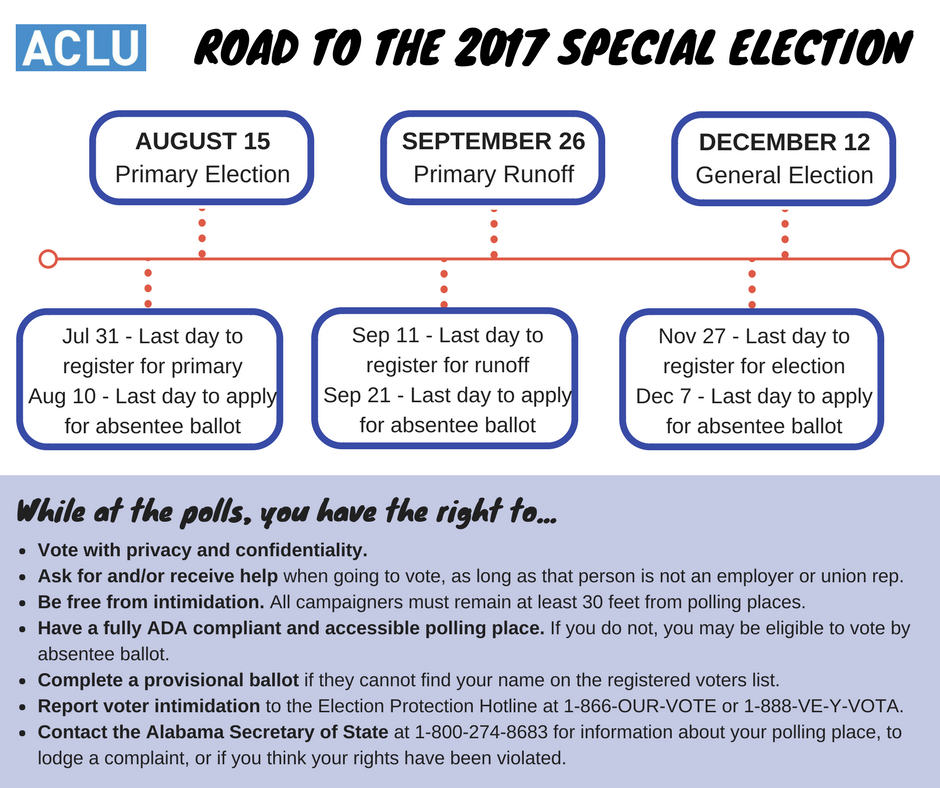
In one week, Alabamians will be heading to the polls for the first step of replacing Jeff Sessions in the Senate, left vacant when he assumed the position of Attorney General of the United States. For those of you interested in making your voices heard by voting, here is what you need to know.
By Sahar Omer
Voting is more than a privilege, it's a right
This weekend marks the beginning of a statewide voting rights restoration campaign that the ACLU of Alabama and Legal Services Alabama are partnering on. Historically, anyone who commits a crime of moral turpitude loses their right to vote in Alabama; however, it has never been clear what specifically was a crime of moral turpitude, which has resulted in inconsistency and confusion across the state.
By Rebecca Seung-Bickley
Speak Freely: The Alabama Governor Just Signed a Bill That Will Restore Voting Rights to Thousands of Alabamians
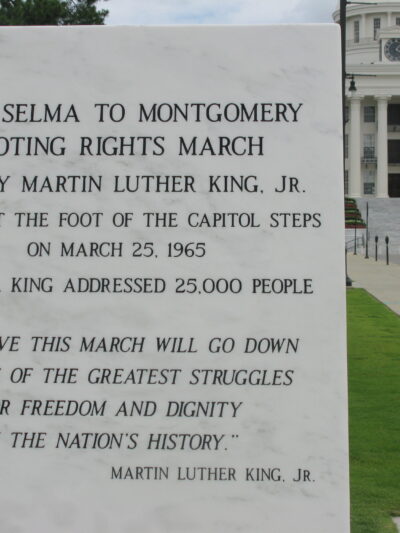
Approved in 1901, the Alabama Constitution disqualifies from voting any citizen convicted of a “crime involving moral turpitude.” That may at first seem racially neutral, but the document as well as the moral turpitude provision were designed with clear racist intent. The drafters intentionally sought to subvert the 14th and 15th Amendments’ protection against racial discrimination in voting by using the moral turpitude provision, in conjunction with discriminatory criminal justice enforcement, to target Alabama’s Black citizens.
By Julie Ebenstein

Speak Freely: Kris Kobach, the ‘King of Voter Suppression,’ Will Lead Trump’s Sham Voter Fraud Commission
President Trump signed an executive order forming a commission to investigate voter fraud and voter suppression after repeatedly claiming, without evidence, that the United States has a “major problem” with illegal voting.

Alabama’s DMV Shutdown Has Everything to Do With Race
Don’t believe a word of it: It’s all about race.Despite state officials’ quick denial that the closing of 31 Alabama DMVs has nothing to do with race, it is a fact that the closures – mostly in poor, majority black counties – disproportionately hurts Black voters. Period.Fifty years ago in Selma, the civil rights movement won a hard fought battle to gain the right to register to vote. It took bloodshed in the streets, lives lost, a march to Montgomery, and the passage of the Voting Rights Act to make sure that African-American citizens had the right to vote. It was all about race.Unfortunately, some things in Alabama never change. When it comes to making sure people can vote, the state of Alabama has on its hands an avoidable problem. Our legislature passed an unnecessary law that put excessive burdens on citizens by requiring them to get a photo ID in order to exercise their fundamental constitutional right to vote — despite the well-known fact that in-person voter fraud is rare.Now Alabama closes 31 0f 67 Department of Motor Vehicle locations where most people get the most commonly used voter ID, the driver’s license. The majority of these counties in the state that are home to poor and Black people are on that list. The photo ID law already disenfranchises voters who are not able to obtain IDs. It has been reported that there are currently 250,000 registered voters who don’t have IDs so are now unable to vote in Alabama unless they either travel outside their county to get a driver’s license or take a burdensome trip to a separate location (which is even harder without a driver’s license!) just for a voter ID. And that disproportionately hurts Black voters.Before the United States Supreme Court gutted the Voting Rights Act in 2013, Alabama would have had to submit this change for review by the U.S. Department of Justice to determine whether the closure was against the law. The fact that it was implemented without approval is just most recent example of why Congress needs to restore the Voting Rights Act.Indeed, the very day that Alabama was no longer required to submit voting changes to the Department of Justice, Alabama announced its implementation of the photo ID requirement that had been delayed because of the requirements of the Voting Rights Act. This is all about race and about what communities are most affected by the state of Alabama’s bad choices.
By Susan Watson

ACLU of Alabama Statement for the SCOTUS Voting Rights Act Ruling
The following can be attributed to Susan Watson, Executive Director, ACLU of Alabama:
We are disappointed that the Supreme Court has put up a roadblock to make voting less free, fair, and accessible. Section 5 of the Voting Rights Act has been critically important to our state. It blocked 46 discriminatory voting laws in Alabama between 1982 and 2006; the state also violated Section 2, another critical provision of the Voting Rights Act that protects against discrimination, 192 times.
We know Congress is committed to protect the rights of minority voters on a bipartisan basis. Congress has reauthorized Section 5 every time since its passage and most recently reauthorized it with overwhelming bipartisan support, which President George W. Bush signed into law in 2006.
Stay Informed
Sign up to be the first to hear about how to take action.
By completing this form, I agree to receive occasional emails per the terms of the ACLU’s privacy statement.
By completing this form, I agree to receive occasional emails per the terms of the ACLU’s privacy statement.