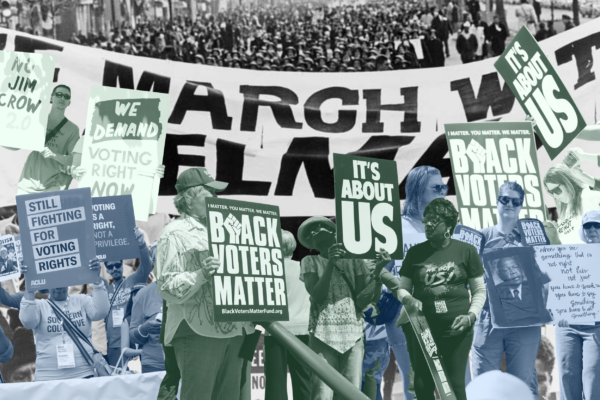
The recent ruling of Louisiana v. Callais has spread a chilling effect throughout the South—but especially in Alabama, the birthplace of the Civil Rights Movement. On March 7, 1965, hundreds of people gathered on the Edmund Pettus Bridge to participate in a march for voting rights in Alabama. What should have been a peaceful display of civic engagement quickly became a globally televised attack on individuals who simply desired change. Bloody Sunday, as it soon became known, was the apex of a decades long struggle for Black enfranchisement and, with the world watching, the United States Congress had little time to respond. On August 6, 1965, President Lyndon B. Johnson signed the Voting Rights Act of 1965 into law.
The Voting Rights Act (VRA) was designed to enforce the Fifteenth Amendment of the United States Constitution. This amendment prohibits federal and state governments from denying the right to vote to citizens because of their “race, color, or previous condition of servitude.” Unfortunately, states like Alabama used harmful strategies like literacy tests and poll taxes to keep Black voters away from the polls. The VRA was meant to undo the lingering effects of Jim Crow and secure Black voter access. Sections 2 and 5, specifically, were drafted to prohibit discriminatory voting practices, allow citizens to file lawsuits regarding said voting laws, and ensure approval had been granted to any changes in voting laws in jurisdictions with a history of discrimination. Louisiana v. Callais has essentially rendered Section 2 obsolete. But this isn’t the first time that crucial aspects of the VRA have been under attack.
In 2013, the United States Supreme Court ruled in Shelby County v. Holder that Section 4(b) of the Voting Rights Act was unconstitutional. The challenge this ruling presented was that, while it did not erase Section 5, it struck down the formula that was used to determine the jurisdictions that needed preclearance. Thus, destroying one of the most important safeguards to protect Black voters. Years later, in 2021, a lawsuit was filed, Milligan v. Allen, against Alabama regarding the state’s new Congressional districts. Despite making up 27% of the voting population, Black voters were unable to elect a representative of their choosing because of the way the existing lines were drawn. The Supreme Court ruled in favor of the Black voters that challenged the maps resulting in the redrawing of the maps to allow Black voters the chance to elect candidates of their choice in two districts.
While we celebrate the victory of Milligan v. Allen, we also acknowledge that Louisiana v. Callais did not happen in a vacuum. It is a signal. A signal that the hard-fought gains of the Civil Rights Movement are still vulnerable. A signal that the promise of equal access to the ballot is still being negotiated. A signal that Black enfranchisement is still seen as optional in some corners of power. But we, at the ACLU of Alabama, are not new to this fight. From our inception in 1965, we have been fighting for the voting rights of all Alabamians. We fought hard in the 1980s with the Alabama Voting Rights Project and that hard work led to the election of the first Black Congressman since the Reconstruction Era in 1992. We continued that fight with Milligan v. Allen which resulted in an additional Black majority Congressional district. And today, we, as freedom’s watchdog, keep fighting in the Courts, in the Legislature, and in the Community for the right to vote for all Alabamians—but especially those whose rights are under attack.
Sixty-one years after the passage of the Voting Rights Act of 1965, the reality for Black voters is both sobering and clarifying: the protections won through blood, sacrifice, and collective courage are still not secure. What was meant to be a transformative safeguard has been steadily narrowed and rendered obsolete. In the wake of decisions like Louisana v. Callais, Black voters are once again being asked to fight—through the courts, through organizing, and at the ballot box—for rights that should have long been settled. The fight for Black enfranchisement has never been theoretical—it’s lived, it’s contested, and it’s ongoing.
We are the legacy of every foot solider who refused to turn back. We are the answer to every attempt to silence our voices. And we are the generation that must decide what happens next. So don’t just watch this moment—move in it. Get informed. Get organized. Get to the ballot. Because our power has never been given. It has always been claimed.