
What’s On Your Ballot This Election Cycle and Beyond
Your Guide to Elected Offices from the Local Level to The Governor’s Mansion
Guide to Your Statewide Elected Officials
The State Executive, Judicial, and Legislative Branches
STATE EXECUTIVE BRANCH
GOVERNOR
TERM: 4 YEARS
- The head of the executive branch executes state laws, commands our Army and Air National Guards, and signs/vetos bills from the state legislature. They also declare state of emergencies, call special sessions for the state, and pardon criminal convictions.
LIEUTENANT GOVERNOR
TERM: 4 YEARS
- The second-ranking officer in the executive branch and the first in line to succeed the Governor. The lieutenant governor acts as president of the Senate and is the tie-breaking vote.
ATTORNEY GENERAL
TERM: 4 YEARS
- They defend Alabama in suits against the state. They also provide legal advice to state and county officers and advisory opinions on the constitutionality of bills as well as request execution dates for prisoners on death row. They may direct the prosecution of any criminal case in any of the courts of the state.
SECRETARY OF STATE
TERM: 4 YEARS
- The Alabama chief election official certifies vote totals, candidate qualifications, and ballots. They also maintain the state government’s official documents and public records.
STATE TREASURER
TERM: 4 YEARS
- They handle all deposits, payments, investments, and other financial dealings on behalf of the state of Alabama.
STATE AUDITOR
TERM: 4 YEARS
- They’re constitutionally required to report annually on all receipts and disbursements of every character, all claims audited and paid out, and all taxes and revenues collected into the treasury.
STATE BOARD OF EDUCATION
TERM: 4 YEARS
- The board consists of nine members who authorize education policy for Alabama and who appoint the State Superintendent.
COMMISSIONER OF AGRICULTURE
TERM: 4 YEARS
- They manage the Department of Agriculture and Industries which oversees farms, animal and plant industry, pesticides, and other agricultural products.
PUBLIC SERVICE COMMISSION
TERM: 4 YEARS
- Tasked with overseeing the regulation of public transport and utilities, this three member commission provides consumers with safe, adequate and reliable services at rates that are equitable and economical.
STATE JUDICIAL BRANCH
ALABAMA SUPREME COURT
TERM: 6 YEARS
- This nine member court is the highest court in Alabama. They are authorized to review decisions of any state court, conclude legal matters other can’t help due to lack of jurisdiction, and set official practices and procedures for all state courts.
ALABAMA SUPREME COURT, CHIEF JUSTICE
TERM: 6 YEARS
- The chief justice acts as administrative head of Alabama’s judicial system but does not have additional authority or power during legal proceedings.
CRIMINAL APPEALS
TERM: 6 YEARS
- This five member court hears matters settled at circuit court level, including exclusive jurisdiction over all misdemeanors, felonies, and habeas corpus.
CIVIL APPEALS
TERM: 6 YEARS
- This five member court hears matters such as divorce, custody, worker’s compensation, and appeals from administrative agencies.
STATE LEGISLATIVE BRANCH
ALABAMA HOUSE OF REPRESENTATIVES
TERM: 4 YEARS
- While both legislative bodies pass bills on public policy matters, set levels for state spending, raise or lower taxes, the House is the only chamber that can originate revenue bills. They are also able to override a gubernatorial veto with a simple majority. There are 105 State House Representatives. Each member represents a district of approximately 40,000 people.
ALABAMA SENATE
TERM: 4 YEARS
- While both legislative bodies pass bills on public policy matters, set levels for state spending, raise or lower taxes, the Senate has the sole power of confirmation of certain appointees. They are also the deliberative body and able to have lengthier debates. There are 35 State Senators. Each member represents a district of approximately 137,000 Alabamians.
Guide to Your County Elected Officials
This list may not reflect all the county elected offices and the responsibilities across the state.
County offices are not elected on the same year in every county across the state. Be sure to refernce your county’s sample ballot for the most accurate information.
PROBATE JUDGE
TERM: 6 YEARS
- Probate judges oversee judicial matters such as name changes and adoptions, public records, elections, issuing marriage licenses, and appointing notaries public.
SHERIFF
TERM: 4 YEARS
- The Sheriff is county’s chief law enforcement officer. Some counties have specific laws which govern the sheriff’s office differently. The Alabama Supreme Court holds county sheriffs as state officers thus making them immune to most legal actions.
REVENUE COMMISSIONER
TERM: 6 YEARS
- Revenue Commissioners are responsible for mapping, appraising and assessing each parcel of property and then collecting tax based upon each parcel’s assessed value.
TAX ASSESSOR
TERM: 6 YEARS
- The Tax Assessor’s responsibility is to discover, list, assess, apply exemptions, abatements, current use, and process real and personal property tax returns.
TAX COLLECTOR
TERM: 6 YEARS
- The Tax Collector is responsible for collecting, investing, and disbursing taxes. They account for the tax money or taxable property and provide budget projection services for relevant agencies.
LICENSE COMMISSIONER
TERM: 6 YEARS*
*Mobile County License Commissioner serves a 4 year term
- The License Commissioner is responsible for the issuance of certain business and professional licenses, motor vehicle licenses, motor vehicle titles, temporary tags, motor vehicle and boat casual sales and use taxes, drivers’ licenses, and conservation licenses.
COUNTY COMMISSION
TERM: 4 YEARS*
*Barbour, Bullock, & Perry Counties are elected to 6 year terms
- County Commissioners develop and adopt county laws on a wide variety of topics such as public health, parks, solid waste management, roads and highways, zoning and land use. One of the central roles commissioners perform in county management is overseeing the personnel system.
COUNTY BOARD OF EDUCATION
TERM: 6 YEARS*
Term may vary in some counties
- County Boards of Education govern local school systems, promote student learning, and prepare students for college and careers. They are responsible for overseeing the education of students in the community.
COUNTY SCHOOL BOARD SUPERINTENDENT
TERM: 6 YEARS
- The superintendent serves as the board’s chief adviser on educational matters and as the district’s educational leader.
CORONER
TERM: 4 YEARS
- The Coroner’s responsibility is to coordinate with law enforcement, the District Attorney’s Office, and the Alabama Department of Forensic Sciences in determining the cause and manner of death, assist families with information regarding autopsy and toxicology results, to sign death certificates, too collect county death statistics, including motor vehicle crashes, overdoses, suicides,
Guide to Your Municipal Elected Officials
This list may not reflect all the municipal elected offices and the responsibilities across the state.
MAYOR | TERM: 4 YEARS
- The mayor serves as the head of the executive branch in city government. The mayor is responsible for overseeing the day-to-day operations of the municipality. They oversee municipal employees, makes sure that bills are paid on time, execute municipal contracts and, in general, perform many of the same functions as a CEO of a private corporation. In municipalities of less than 12,000 people, the mayor also presides over council meetings and serves as a member of the council. In these cities and towns, the mayor may vote on any issue before the council, introduce measures and participate in debates to the same extent as members of the council. In cities with populations of more than 12,000, the mayor is not a member of the council. However, they have a veto over any permanent action taken by the council. The council can override the veto by a two-thirds vote.
CITY COUNCIL | TERM: 4 YEARS
- The council is the legislative branch of city government. The council has authority over the finances and property of the municipality. The council establishes policies, passes ordinances, sets tax levels, determines what sorts of services the municipality will offer and has authority over all other legislative aspects of municipal government. Individual councilmembers, acting alone, have no greater power or authority than any other citizen of the municipality. The council can only act as a body at a legally convened meeting. No official action may be taken by any individual council member.
CITY BOARD OF EDUCATION
- The primary function of the school board is to oversee the education of students in the community. The board’s role is to establish a vision for the system, adopt written policies and programs, act on personnel recommendations, consider and approve operating budgets, and advocate for the needs, resources, and interests of public school students.
- Details regarding term length and the election vs. the appointment of city school board members vary based on the local law enacted.

Alabama Election Cycle Calendar
Alabama Elections through 2030
Learn More About the Amendments on Your 2026 Midterm Ballot
How the Vote Works
Alabama voters will have a chance to vote on four statewide constitutional amendments on their Midterm ballot.
Each amendment is a yes-or-no question. A yes vote adds the change to the Alabama Constitution. A no vote keeps current law in place.
All four amendments were approved by the Legislature in the 2026 regular session, and each needs a simple majority of votes to pass. The Alabama Fair Ballot Commission adopted plain-language explanations of each, which are posted on the Secretary of State’s website and will be available at polling places.

Each amendment is a yes-or-no question. A yes vote adds the change to the Alabama Constitution. A no vote keeps current law in place.
All four amendments were approved by the Legislature in the 2026 regular session, and each needs a simple majority of votes to pass. The Alabama Fair Ballot Commission adopted plain-language explanations of each, which are posted on the Secretary of State’s website and will be available at polling places.
The Amendments on Your 2026 Ballot
Read the ACLU of Alabama’s amendment explainers.
Amendment 1: Lieutenant governor vacancy
This amendment creates a way to fill a vacancy in the lieutenant governor’s office when it occurs more than 60 days before the next general election. This provision does not require an immediate standalone special election. It also lets the Legislature set the pay of the lieutenant governor and legislative officers by joint resolution.
- Yes: A vacancy could be filled at the next general election instead of staying open until the next regular election for the Lt. Governor. The Legislature could set those salaries by joint resolution.
- No: Current rules stay in place. No one automatically becomes lieutenant governor, and the Senate president pro tem presides over the Senate in the interim.
Source: SB 271, Sen. Sam Givhan (R-Huntsville). Passed both chambers unanimously.
Amendment 2: Merging county school systems
This amendment creates a process for county boards of education to merge. It requires the State Board of Education to conduct an impact study before a merger and provides for a protest and referendum.
- Yes: County school systems would have a set process to consolidate. If at least 25% of registered voters in an affected school system file a written protest, a majority of voters must approve the merger at the next general election.
- No: This consolidation process and its protest and referendum steps would not be added to the constitution.
Source: HB 380, Rep. Terri Collins (R-Decatur). Passed the House 96-2 and the Senate unanimously.
Amendment 3: Pledge of Allegiance and student-led prayer
This amendment addresses the daily Pledge of Allegiance and student-initiated prayer in public K-12 schools.
- Yes: School boards would have to adopt policies requiring public K-12 schools to say the Pledge of Allegiance daily. Boards could also adopt policies allowing student-initiated, student-led prayer. Students who do not wish to participate could leave the classroom during both.
- No: There would be no constitutional requirement for a daily Pledge and no added constitutional authorization for these prayer policies. Current law and local policies would continue.
Source: HB 511, Rep. Reed Ingram. Passed the House 94-4 and the Senate unanimously.
Amendment 4: Weekly national anthem
This amendment addresses a weekly broadcast of the national anthem in public K-12 schools.
- Yes: Local school boards would have to adopt policies requiring public K-12 schools to broadcast the first stanza of The Star-Spangled Banner once a week. It could be performed by a school-approved band, choir, vocal group or vocalist, using the version archived by the Library of Congress.
- No: There would be no constitutional requirement for weekly anthem broadcasts. Schools would follow current law and local policy.
Source: SB 5, Sen. Gerald Allen (R-Cottondale). Passed the Senate 22-5 and the House 75-27.
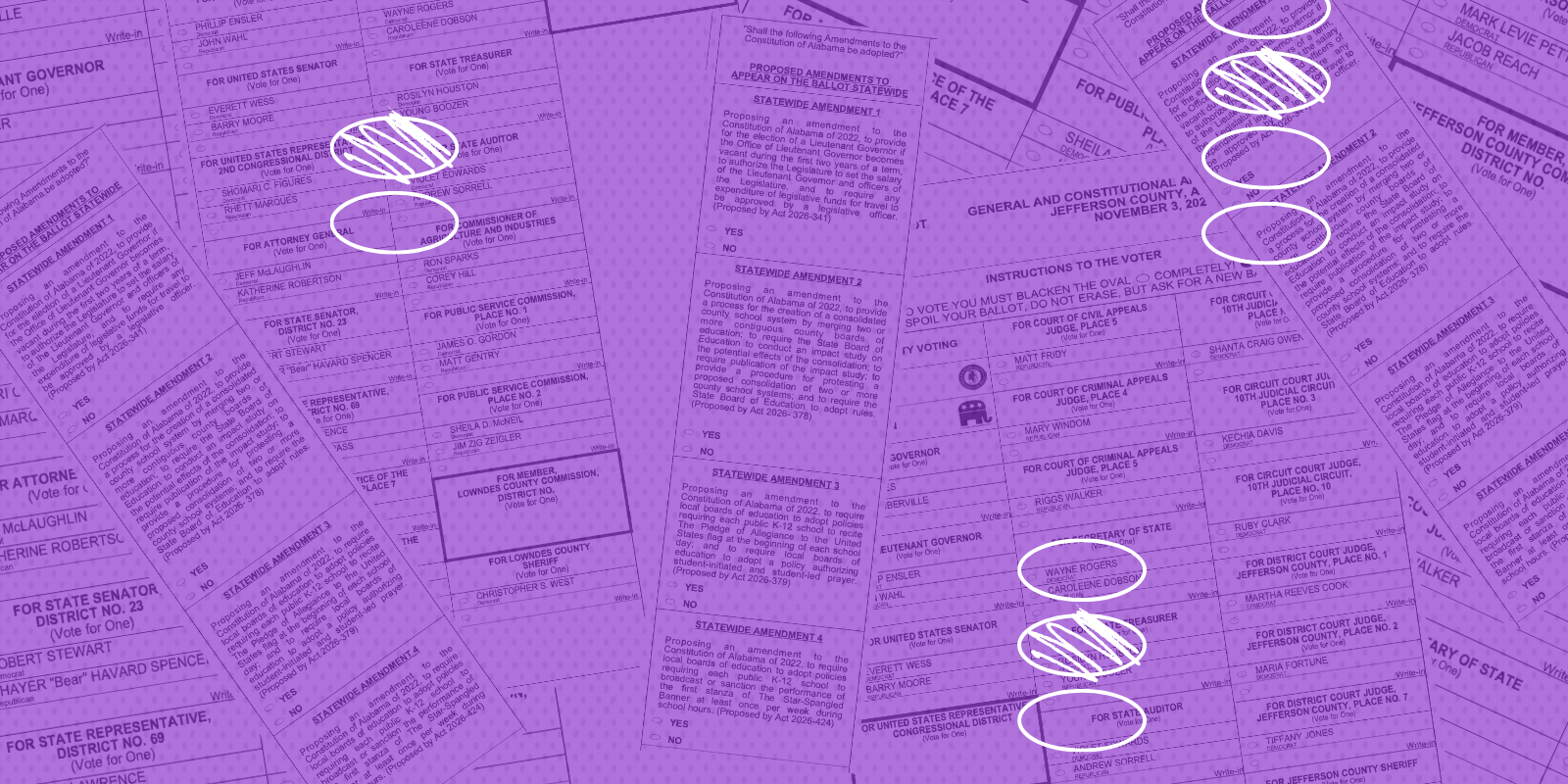
Amendment 1: Lieutenant governor vacancy
This amendment creates a way to fill a vacancy in the lieutenant governor’s office when it occurs more than 60 days before the next general election. This provision does not require an immediate standalone special election. It also lets the Legislature set the pay of the lieutenant governor and legislative officers by joint resolution.
- Yes: A vacancy could be filled at the next general election instead of staying open until the next regular election for the Lt. Governor. The Legislature could set those salaries by joint resolution.
- No: Current rules stay in place. No one automatically becomes lieutenant governor, and the Senate president pro tem presides over the Senate in the interim.
Source: SB 271, Sen. Sam Givhan (R-Huntsville). Passed both chambers unanimously.
Amendment 2: Merging county school systems
This amendment creates a process for county boards of education to merge. It requires the State Board of Education to conduct an impact study before a merger and provides for a protest and referendum.
- Yes: County school systems would have a set process to consolidate. If at least 25% of registered voters in an affected school system file a written protest, a majority of voters must approve the merger at the next general election.
- No: This consolidation process and its protest and referendum steps would not be added to the constitution.
Source: HB 380, Rep. Terri Collins (R-Decatur). Passed the House 96-2 and the Senate unanimously.
Amendment 3: Pledge of Allegiance and student-led prayer
This amendment addresses the daily Pledge of Allegiance and student-initiated prayer in public K-12 schools.
- Yes: School boards would have to adopt policies requiring public K-12 schools to say the Pledge of Allegiance daily. Boards could also adopt policies allowing student-initiated, student-led prayer. Students who do not wish to participate could leave the classroom during both.
- No: There would be no constitutional requirement for a daily Pledge and no added constitutional authorization for these prayer policies. Current law and local policies would continue.
Source: HB 511, Rep. Reed Ingram. Passed the House 94-4 and the Senate unanimously.
Amendment 4: Weekly national anthem
This amendment addresses a weekly broadcast of the national anthem in public K-12 schools.
- Yes: Local school boards would have to adopt policies requiring public K-12 schools to broadcast the first stanza of The Star-Spangled Banner once a week. It could be performed by a school-approved band, choir, vocal group or vocalist, using the version archived by the Library of Congress.
- No: There would be no constitutional requirement for weekly anthem broadcasts. Schools would follow current law and local policy.
Source: SB 5, Sen. Gerald Allen (R-Cottondale). Passed the Senate 22-5 and the House 75-27.
Related Issues
Related Content

- Voting Rights
Project MOVE

- Voting Rights
Milligan et al. v. Allen et al.
- Voting Rights