
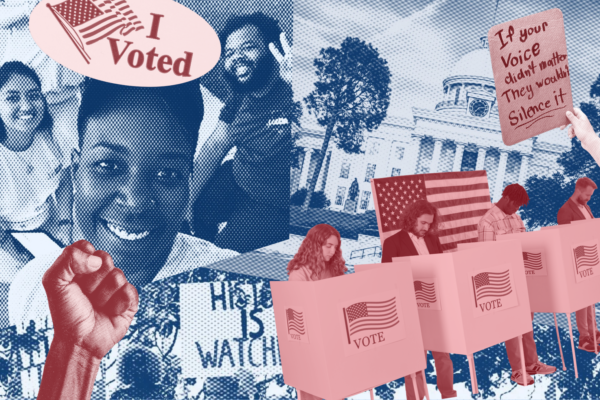
For years, the ACLU of Alabama has fought to protect and expand voting rights across the state. Today, that work is more critical than ever. Politicians have attacked the beating heart of our democracy: the right to vote. On April 29, 2026, the U.S. Supreme Court issued its Callais decision, gutting the Voting Rights Act of 1965. In wake of the ruling, Governor Kay Ivey called a special legislative session to redraw Alabama’s congressional districts, paving the way for Alabama to reinstate a map that a federal court previously found violated both Section 2 of the Voting Rights Act and the U.S. Constitution. And on June 2, 2026, the Supreme Court voted 6–3 to allow Alabama to use this congressional map that intentionally dilutes Black Alabamians’ voting power for the 2026 midterm elections. While this decision is deeply disappointing, it also reinforces what we know well: this work requires more than legal strategy. It requires coordinated, sustained work through litigation, education, and on the ground organizing.
Despite these setbacks, the ACLU of Alabama is committed to protecting the right to vote, mobilizing communities, and increasing voter participation across the state. That’s where Project MOVE (Making Our Voices Echo) comes in– the ACLU of Alabama’s turnout initiative focused on increasing voter participation in Black and Brown communities across the state. Through community engagement, advocacy, and voter education, Project MOVE equips registered voters with the knowledge and resources they need to understand and exercise their rights at the polls. While district lines may be redrawn and barriers to voting may create challenges, the power of the people remains. Project MOVE reinforces a simple but powerful message: They can redraw district lines, make the process harder, make you feel like your voice doesn’t matter, but they cannot take away the power of people who show up.
To make sure your voice is heard and your vote is counted in the 2026 midterm election, we’ve gathered resources on your rights at the polls, what to take with you to vote, and important dates to remember. Read through this information below and be sure to check out our 2026 Voter Guide to make a plan to vote.
Important Dates for Voters to Remember:
- OCT. 27 – Last day to apply for an absentee ballot by mail
- OCT. 29 – Last day to apply for an absentee ballot in person
- NOV. 2 – Last day for voters to hand deliver an absentee ballot
- NOV. 3 – Absentee ballots returned by mail must be received by noon
- NOV. 3 – 2026 GENERAL ELECTION DAY!
Where to Vote:
The Congressional and State Senate Maps have been redrawn. The new district lines for Congressional Districts 1, 2, 6 and 7 will be in effect for the Nov. 3, 2026, general election. Additionally, State Senate Districts 25 and 26, which cover Montgomery and Crenshaw counties, and part of Elmore County, have also been impacted by the recent Supreme Court decision. Your voting district may have changed since you last went to the polls. Check your district information at AlabamaVotes.gov.
What’s on the Ballot:
Make sure that you are prepared to vote by researching what’s on your ballot. This election cycle, voters will have cast ballots for Alabama’s next governor, and other elected officials the federal, state, and county level. Additionally, there are four amendments to Alabama’s constitution on your ballot. For more information on thos amendments, as well as who is on your ballot this election cycle, what they do, and how long they serve, check out our guide to your elected officials here and download a sample ballot for your county today.
Voting Requirements:
- Alabama law requires registered voters to present a valid photo ID to cast a vote. Accepted forms of identification include a driver’s license (from any state), an Alabama non-driver ID, an Alabama photo voter ID, a U.S. passport, a government employee ID, a Military, Tribal, or Prison ID, or a student ID from a post-high-school institution. Click here for more I.D. options.
Voters have the right to:
- Vote with privacy and confidentiality.
- Ask for and receive help when voting, as long as that person is not an employer or union representative.
- Be free from intimidation from campaigners.
- Have a fully ADA-compliant and accessible polling place. Voters identified under the ADA can also request assistance or accommodation to cast a ballot including audio or visual enhancements. Additionally, voters aged 65+ may walk directly to the poll check-in desk to avoid long periods of standing in line.
- Vote a regular ballot even if listed “inactive.” A voter listed as “inactive” is eligible to vote on a regular ballot after filling out an update form.
- Complete a provisional ballot if you forgot your voter ID or if they cannot find your name on the voter rolls.
- Bring a sample ballot into the polling place for use in the voting booth.
- Remain in a voting booth for four minutes. If you need assistance, you are entitled to at least an additional five minutes to vote.
- Lodge a complaint or contact the Alabama Secretary of State at 1-800-274-8683 if you think your rights have been violated.
Election Day Transportation Assistance:
Need a ride to the polls on November 3rd? Contact one of our partner organizations to schedule a ride:
- Lift Our Vote
-
- Local: 256.701.4182
- Rolling to the Polls:
-
- Toll Free: 866-4-AL Vote (425-8683)
-
- Local: 334-625-0758
-
- SMS: Text Vote334 to 31996
Election Protection Hotline:
Can’t find your polling location? Did your polling location close early or change locations? Another issue at your polling location? Call our non-partisan Election Protection Hotline with all your questions and concerns at
- ENGLISH: 866-OUR-VOTE (687-8683)
- SPANISH: 888-VE-Y-VOTA (839-8682)
- ASIAN LANGUAGES: 888-API-VOTE (274-8683)
- ARABIC: 844-YALLA-US (925-5287)